Tools for Musicians

How To Find New Fans AND Make Social Media Updates Easy

By NationWide Source Estimated reading time: 5 minutes

Everyone wants to make their life a little easier. Especially independent musicians. From being the artist to the tour manager to the PR specialist, indie artists have a lot on their plates. So when we find a tool that frees up a little of your time and does its job well, we get excited.

Enter Bandsintown.

Bandsintown is a website and app that lets music fans track their favorite artists. Then it lets those fans know when the artists they tracked comes to town. 65% of all touring artists in the United States use Bandsintown, and they have over 120 million fans subscribed to their service. For the artist, it’s an easy tool to use. Bandsintown adds a “Tour Dates” tab to your Facebook page, and you can manage everything from there. It’s a simple concept that has some great features. So let’s dive into why Bandsintown might be a good tool for your band.

Social Media Updates

A few weeks ago we posted a blog about ReverbNation, and it warned against letting third parties automatically post concert updates to Facebook for you. We cautioned against using this feature on ReverbNation primarily because there was no way to control these posts, besides turning them on and off. They tended to fill up artist’s Facebook and Twitter with duplicate content that had the potential to drive fans away.

This is not the case with Bandsintown. Their automatic posting feature has tons of options that let you control exactly what is posted.

If you choose to turn these posts on in Facebook, you can also target them geographically. This a great feature. It makes sure you’re not bothering all your West Coast fans with your extensive touring in the Northeast.

Post to Reginal

It’s also notable that the “Tour Dates” tab allows you to upload a custom video header. This is great news, because it allows your fans to engage with visual content before they browse your tour schedule. It’s been shown that visual content (graphics and video) tend to create higher response rates with viewers, so having this built into the page where your shows are displayed is a great feature.

Screen Shot 2015-07-13 at 11.55.56 AM

Fan Analytics

Fans are the lifeblood of any musician. And having data about those fans can mean the difference between a successful tour or playing to empty rooms every night. If you have over 100 trackers (fans) in Bandsintown, you can receive fan analytics.

Probably the best feature in these analytics is the fan heat map. This tool allows you to see where the fans that track you live, where fans who track similar artists live, and the locations of fans who have RSVP’d to your shows. This helps you to create a tour schedule that will have the most impact for you.

Heatmap

They also create a list of the top 100 markets for your live show based on the number of trackers in each city, and show you a graph of actual RSVPs for your shows vs. people who are interested in attending.

RSVP vs. Interested

Google Loves Bandsintown

Bandsintown has a nice looking widget that you can embed onto your official website to display your tour dates. This is handy because you only have to upload your show dates once and they will be live on your official website and social media.

Another bonus is that Bandsintown has partnered with Google to streamline the ways that events show up when you search for a band. Since Bandsintown and Google are buddies, all your show information is easy for Google to read, and shows up clearly.

Screen Shot 2015-07-13 at 2.08.05 PM

Another benefit to Bandsintown’s relationship with Google is YouTube Cards. YouTube hopes to replace annotations in videos with small rectangular boxes called cards. These cards are small pictures with text, and will display on desktop as well as mobile browsers. You can link these cards to your official website if you’ve already affiliated your YouTube channel with your website. However, if you want to use YouTube cards to sell anything, you have to use a retailer that has already been approved by YouTube. The good news is that Bandsintown is on that list.

Hozier YouTube

But the best news about this feature?

When you use Bandsintown on your YouTube card, the card will link directly back to your website.

This is great news for artists, and is vastly different than many third party applications that will take your fans to their website instead of your own.

What Not to Do With Bandsintown

Just like any other online tool, there are some things you need to be careful of when using a third party app to help you out.

  • Don’t let Bandsintown social media posts take over your profile.  Just because the social media posting feature works well doesn’t mean it is a replacement for actual posts created by you. Even though Bandsintown gives you lots of posting customization options, if all your fans ever see are these posts, they will probably check out pretty quickly. You can read our blog for tips on managing your social media profiles here.
  • Don’t let Bandsintown gather all your fan data for you. Although they have some great analytical tools, you don’t ever want a third party to be the main way you gather information about fans. If third parties are the only way you’re collecting fan data, if they ever shut their doors, you will be left high and dry with no way to communicate with fans.
  • Don’t Let Bandsintown Emails Replace Your Regular Newsletters. It’s great that Bandsintown will automatically send your fans an update when you’re playing in their area, but a personal newsletter written by you is a better way to engage with fans. Many email newsletter services also allow you to geographically target your email audience. Using Bandsintown and your favorite e-newsletter platform in conjunction with each other can optimize your fan interaction, and help get those fans out to your shows.

Overall, Bandsintown is a well built, professional tool that can help artists manage the planning and promotion of their shows, and I would recommend it to almost any artist. But as always, do some experimenting and find out if this app is something that will work for you and your music. If you want more information, you can check out Bandsintown’s official website here.

Have you used Bandsintown? What are your favorite features? Has it helped you to plan more effective tours, and get fans out to shows? Let us know in the comments below!


Leave a comment
...Keep Reading

How to Add Your Music to Gracenote in 5 Easy Steps

By NationWide Source Estimated reading time: 3 minutes

Here’s the scenario: Your fan just bought a CD at a show. They are so excited to listen to it that they immediately take it out of the package and put it into the CD player in their car. After having it in their car for a few weeks, they finally decide to take it inside and add your music to their iTunes library. They put the CD into their computer, and iTunes pops up to import it. But no track or artist information is listed.  Unfortunately, they left the CD packaging in the car and don’t remember all the titles to your songs. They still import it, but your music gets moved down to the bottom of the their music library, with no way to distinguish it from all the other annoying untitled tracks.

This is a problem that can be easily solved. Gracenote is a music recognition service that is employed by many major music retailers and other music services to provide metadata about music files.

Metadata is data about other data. It seems complicated, but actually it’s pretty simple. If you have an mp3 file (the original data), the metadata (data about the original data) might include the artist name, track name, album name, genre, or even the album artwork.

It’s important to have this metadata attached to your files so that you music can be recognized easily, and Gracenote is the most widely used way to make this data available.

Getting Your Music To Gracenote

The great thing about Gracenote is that it is really simple. There are two ways to add your music to their database.

Digital Distribution

If you are distributing your music digitally, Gracenote might be included in your distribution pack. This is the most convenient way to upload your metadata, because your distributor already has all the information.

Major online distributors like TuneCore, and CD Baby (Gracenote is included in their Mega Distribution bundle) will add your metadata information when you upload your files. As long as you entered all the information correctly when you submitted your music, all your metadata information will be correct.

Manually Entering Information

If you are not using an aggregator that automatically uploads metadata to Gracenote, don’t worry. Entering your metadata is an incredibly easy process.

Step One: Simply put your CD into your computer, or upload an mp3 into your iTunes library. However, if you just upload an mp3, make sure it is a finished—hopefully mastered—product, because Gracenote uses the duration of your songs to recognize them in iTunes.Screen Shot 2015-07-10 at 11.33.47 AM

Step Two: Gracenote might show you a fuzzy matches dialog box of albums that could be matches. Close this box if it pops up.

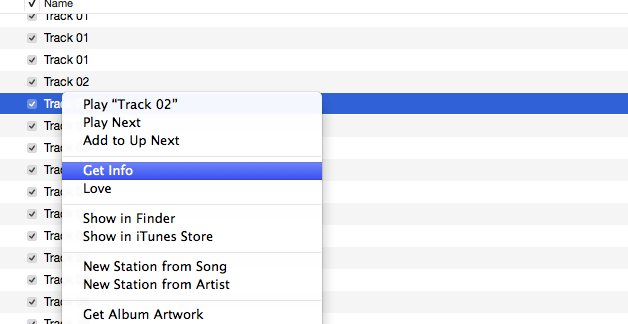
Step Three: Right click on one of the track names and choose the option “Get Info.”Get Info

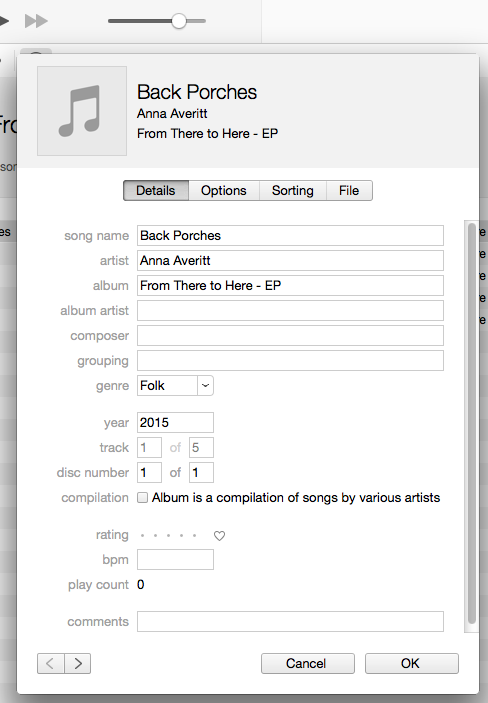
Step Four: Enter all the information for each song exactly as you want the metadata to appear. Screen Shot 2015-07-10 at 10.59.02 AM

Step Five: If you are using the latest version of iTunes, there will be a button on the right that says “Options.” Click this button and choose  “Submit CD Track Names…”Screen Shot 2015-07-10 at 10.56.24 AM

A dialog box to choose a genre will pop up if the genre you have currently selected is not supported by Gracenote.

Screen Shot 2015-07-10 at 11.00.10 AM

Click the submit button, wait 2-3 days and then insert your CD again. Your metadata will either be automatically entered, or you will choose from a list of albums that exactly match the duration of each of your songs. Mine only had one other exact match, so it was easy for me (and my fans!) to find the correct information.Screen Shot 2015-07-10 at 11.00.34 AM

If you have any more questions, or your metadata hasn’t appeared after a few days, you can visit Gracenote’s official site to get some help.


1 Comment
...Keep Reading

Apple Music: A Review for Musicians

By NationWide Source Estimated reading time: 4 minutes

Yesterday Apple released the latest iOS update that included Apple Music. This buzzed-about service officially puts Apple into the world of streaming along with Spotify, and Rdio. The update also includes a heavy emphasis on radio-both traditional live radio and custom stations based on user’s choices.

This launch is a big deal to musicians. Will Apple Music be able to make streaming a viable part of a musician’s income? Will its paid-only service be able to attract enough fans to make a difference?

The most important thing that we need to know right now, as a community of artists, is if Apple Music is actually going to appeal to the masses. Music fans are what keep artists going, and if any streaming service is going to work, it has to be backed by fans.

Does Apple Music Meet Fan Needs?

This release has garnered mixed reviews, but the general view is that Apple Music is powerful, but is busy and hard to navigate. There are great features, such as Siri’s ability to control the app and find specific music for you without ever pushing a button. The app also seamlessly integrates with your current iTunes library. If a fan wasn’t already a convert to streaming music, this app makes it incredibly easy for them to make the switch.

These things are great features, but they are somewhat overshadowed by the sheer volume of content in the app. It’s slightly confusing to navigate between the different tabs, and each tab seems to have about a million options. However, these slightly confusing problems are not deal breakers, though they limit the app’s usefulness.

If fans were hoping that Connect would bring them closer to their favorite artists, they were probably a little disappointed today. The Connect tab is pretty bare. This could change as artists invest some time into uploading content, but so far, Connect is fairly disappointing.

Apple Music for Artists

So what should artists do in the wake of this massive and highly publicized launch?

Use All Streaming Services Wisely

We’ve talked about it before, but streaming services shouldn’t be the main way you get fans to listen to your music. When used well, streaming can be an effective tool for marketing your music. However, with the current way that streaming pays artists, you shouldn’t count on it as a major income stream. Instead, leverage the people who find you and follow you on streaming services and try to take them from casual listeners to real fans.

Use Connect to Actually Connect

Apple touts Connect as a place for artists to post exclusive content to fans. This is great in theory, except that there is no way to monetize this content, and there is no way for artists to capture fan information. The word exclusive is also misleading, since anyone can log onto Connect (you don’t have to have a subscription to Apple Music), and you can post the same content on Connect that you post to any number of social media sites.

But Connect does give fans a way to look at your profile while their streaming your music. Connect has the potential to let fans and artists interact directly in the service they use to purchase music, and this is a good thing. You’ve gotten a fan’s attention, and you can use Connect to post content that will encourage them to engage with you further. You should use Connect like any other social media outlet. You can direct fans to your website, post about shows or new releases, or let them know where they can sign up for your mailing list!

I will insert a disclaimer into this: Remember when I told you I had a problem with Apple Music allowing me to claim my Connect profile? As of July 1st, this is still a problem. My music is available on Apple Music’s streaming service, but I can’t log into Connect to post to any potential fans. My account is still awaiting verification.

Apple should probably also be worried that artists just won’t post on Connect. This was Apple’s problem with the failed music social network Ping. Since the content that artists are posting to Connect is probably not different than what musicians are already offering on Facebook, Twitter, and Soundcloud, artists have to decide whether the extra time spent updating another social media profile is really worth it. Connect also doesn’t work from a desktop computer. It is only accessible through the iPhone and iPad app. This limits the service’s functionality, especially if you like to do most of your social media posting from a computer.

Ultimately, it all comes down to the fans. If the users of Apple Music love the service, and it becomes the go-to place for people to listen to their favorite music, than the creators will have to follow, or be left in the dust. (remember Myspace?)

We will keep you updated as we learn more details about how much Apple music is actually going to pay artists, and if Connect actually works to keep musicians and fans, well, connected.

Do you have any thoughts on Apple Music? Do you this this is going to drastically alter the way fans consume music? Let us know it the comments!


Leave a comment
...Keep Reading

Should You Use ReverbNation?

By NationWide Source Estimated reading time: 8 minutes

ReverbNation is a music-specific social network that over 3.5 million artists use. From digital distribution and web hosting to gig opportunities, ReverbNation seems to have it all. But do you need a ReverbNation profile?

To decide if ReverbNation is a good fit for you, you have to ask yourself this question:

Is ReverbNation actually helping my career?

ReverbNation has some useful tools. But some of its features might do more harm than good to your music career.

What Not to Do On ReverbNation

We want you, the artist, to market your music effectively, engage with fans well, and have a successful career. Part of that is using the tools available to you wisely. So we’ve outlined some things to steer clear of when you use ReverbNation, and a few things that ReverbNation might be able to help you with.

Don’t let ReverbNation’s automated social media posts replace your personal interaction with fans.

ReverbNation easily syncs with major social media networks like Facebook and Twitter. ReverbNation can automatically post information about your shows to other social networks. It will continue to post show information as it gets closer to the show date. While this sounds like a great thing, ReverbNation won’t let you control when those things are shared, or how often.

This is a problem.

ReverbNation’s posts tend to fill up your profile with impersonal concert notifications.

While it’s great to let fans know when and where you’ll be playing, these impersonal post soon begin to look like spam. This can frustrate and annoy fans, which is the last thing you want to do.

If you let ReverbNation post to Facebook, it can also lower your position on your fans’ newsfeeds. Facebook has a very specific algorithm that dictates what gets placed into newsfeeds. Numerous duplicate posts could get flagged in Facebook’s program, and mean a lower fan reach.

Do have a regular social media posting schedule.

A status that you took the time to write is better content than a computer generated post about a show. When your social feed is full of automated links, it can make you look like you don’t care about interacting with your fans.

ReverbNation’s automatic posts won’t harm you if your newsfeed has lots of organic posts.  When the automated updates are interspersed with personal content, fans can get excited that you are announcing shows, instead of frustrated that their feed is full of unwanted notifications.

Don’t sacrifice a great website.

ReverbNation has the ability to create a good looking website, that is mobile and tablet friendly.  But I have a major problem with ReverbNation’s website builder.

There are only three templates, and almost no customization.

While Reverbnation’s website design and hosting is easy to set up, the lack of personalization cuts down on the usefulness of this service. You want your website to be an accurate representation of who you are as an artist, and you want it to be a place where you can interact with fans. In my opinion, ReverbNation’s sites don’t allow you to do that.

As a quick example, let’s check out one of the bands that ReverbNation uses to showcase it’s website building feature: Skyward.

reverbnation website builder

Skyward is an independent alternative rock band from Harrisonburg, VA, and I reached out to talk to them about how their band utilizes ReverbNation. The first thing I asked them about was web hosting. They told me that even though ReverbNation features the Skyward website on their information page about site building, Skyward does not actually use the ReverbNation website tool, instead they use a design/hosting platform from Wix for their homepage.  If a band that is featured on ReverbNation—specifically on their information page for site building—doesn’t use the service, that tells me that something about their web design platform did not meet the expectations of Skyward.  ReverbNation may want to update their information page with a band that is actually using them to design/host their site.

Do have a website.

If you don’t currently have a website, ReverbNation’s website builder might be a good place for you to start. Having a website with almost no customization is better than having no website at all, and if this fits your need, then ReverbNation offers a good solution for beginners.

Social media profiles, including your ReverbNation profile, are not a substitute for good website.

So if you don’t have a website, and aren’t sure how to go about creating one, ReverbNation might be a good place to start.

However, if you are willing to spend a little extra time, you can have a much more custom website with the same tools at about the same price. There are lots of web hosting and design services that have comparable prices to ReverbNation, and allow you to fully build the best website for you. I recommend WordPress, Square Space, or Wix.

Don’t expect hundreds of new fans.

While ReverbNations boasts that they have 3.5 million bands signed up on their site, they never let us know how many fans have profiles. There’s no doubt that some music fans are on ReverbNation, but is it a site that hoards of fans visit to find new artists? Probably not.

The majority of users on ReverbNation are other artists. Don’t make the mistake of thinking that a ReverbNation website will generate fan traffic and get you noticed. Try this simple test – ask the next 20-30 people you meet how they listen to music. Track how many tell you they log onto ReverbNation to find new music, I think you will find the number is small or possibly zero.  When I tried it not one of my people said ReverbNation.

If you want genuine interaction with fans, new and old, ReverbNation is probably not the place to do that.

I asked Skyward if they’ve had success connecting with new fans on ReverbNation, and their guitarist Jordan Breeding said:

I’m pretty sure no casual music fan ever hops on there, creates a profile, and then looks for new bands. It seems that most of the members are just other musicians. That limits its usefulness in my opinion.”

Do spend time creating relationships with fans

ReverbNation probably isn’t the best place to connect with fans. Finding out where your target audience communicates will help you build meaningful relationships with fans. Try Twitter, Instagram, Facebook, or Patronage.

Don’t spend all your time randomly submitting to gig opportunities

There are thousands of live show and press opportunities on ReverbNation. In theory, having thousands of potential gigs at your fingertips is wonderful. But there are problems. One issue is simply sorting through them all. You have to find the opportunities that are relevant to your band that you actually have a chance of booking.

Remember, there are literally millions of bands on ReverbNation trying to compete for the same opportunities as you.

You also have to pay to submit to many of the opportunities on ReverbNation. While this is not necessarily a bad thing, if you don’t get the gig, that money is gone. So if you choose to submit to these gigs, make sure you are paying attention to the cost.

Do submit to opportunities that can genuinely enhance  your career.

When looking for opportunities on ReverbNation use your time—and your hard earned cash—well. Spend it on things that are actually going to enhance your career. Some people successfully find gigs on ReverbNation. Other artists don’t.

The guys in Skyward have had some moderate success with ReverbNation opportunities. They recommend looking for opportunities based on geography. You’re much more likely to have the chance to play at a local festival that uses ReverbNation than at a festival thousands of miles away. You always have to keep in mind that you are competing with thousands (or millions!) of other musicians. But if you’re smart about where you spend your time and money, and it might pay off!

Useful Tools

There are things you probably shouldn’t be using ReverbNation for. But it can be a great tool when you use it wisely.

ReverbNation offers digital distribution at good prices, and their services are comparable to many other aggregators.  And if you are already paying for the premium tier of ReverbNation, digital distribution is included.

They also offer a great rate when you sell downloads from their online store. Selling downloads is even available with a free membership! Musicians keep 87% of the revenue they generate from selling their music on ReverbNation. That’s quite a bit more than the 70% you’ll make from iTunes.

Reverbnation also offers a great looking Electronic Press Kit. If you need something simple, effective, and streamlined to send to promoters, ReverbNation’s press kits are good looking, easy to set up, and offer great tools like integrated fan stats. You can even see who opened your press kit, and exactly what they clicked on.

Another advantage of ReverbNation is that it keeps everything in one central location. This is Skyward’s favorite feature. Guitarist Jordan Breeding says:

“It’s definitely very helpful as far as being able to hold all of our music/videos/photos/schedule in one convenient place and then incorporate that stuff onto our Facebook and personal website. It can also be a helpful way to contact certain venues or other bands in the places where we travel.”

Thanks to Skyward for their input in this article. You can checkout their music here, and their ReverbNation press kit here.


1 Comment
...Keep Reading

Keep Your Audience Listening: How To Add Interest to Your Live Show

By NationWide Source Estimated reading time: 6 minutes

Last week I told you about a show I went to. I liked the artist’s music, but found it difficult to focus on his performance. I went home and began to ask myself why I wasn’t engaged with this artist’s show.

I realized one of the main reasons I was having trouble paying attention was because his whole show looked exactly the same.

Most live shows have three key elements. The music, the script— the order you play the music in, and what you say between the music— and the visuals.

People come to see a show, not hear it.

Let me clarify: If your music is bad, it doesn’t matter how great your visuals are. Well rehearsed, well written music is absolutely essential. But your audience isn’t paying to hear an exact copy of your album. They bought a ticket because they want an experience. And the visual aspect of your show is crucial in keeping people engaged with what’s happening onstage, and giving a night they’ll remember.

The Essentials: Onstage Movement

Having a road map of changing visuals for each of your songs is a great idea. When you have a general idea of what everyone is doing for each song, you can make sure that you have lots of visual interest and diversity in your show. This will help keep your audience focused on you throughout your entire show.

During your rehearsals, try setting your self up as close as possible to how you will be set up for a gig. Then run through your set exactly like you would at a show. Play your music in the right order, and run through your transition exactly how you would if you were playing in front of an audience. As you’re rehearsing, find places you can add something visual to. Here are three starting points:

  • Try to figure out where you can interact with other members of your band. If you’re the singer, turn around and jam with your drummer. Or if your guitarist should walk over to the bassist. If your guitarist has a solo, or is being featured for a section, have the lead singer look at him, or even walk over to him. This action helps the audience know where to look, and signals them that something new and exciting is happening.
  • Visually highlight dynamic changes. Are you going from an upbeat and exciting part of your set to a quieter, more intimate section? Bring out a stool, have your drummer take a break, and show your audience visually that you’re about to take them to someplace completely new.
  • Make eye contact. In any kind of ensemble, a little eye contact goes a long way. When your band is a tight knit unit, and looks like one, the audience can feel that camaraderie, and you can invite them to participate in it. When they feel connected to— like they are a part of something— that’s when you’ve gained a fan.

Riding Solo

Now, not all of these suggestions are going to work for everyone. What if you play by yourself, or with one other person?

If you are in a smaller ensemble, and chained to an instrument and your mic stand, don’t despair! There are things that you can do to add visual interest to your show.

The first thing to do is look at your facial expressions. You might want to try rehearsing into a mirror, or a webcam. If you make the same face the whole time, work on matching your facial expressions to your lyrics. Maybe all you need to do is practice smiling. Looking like you’re enjoying yourself onstage goes a long way in getting the audience to enjoy your performance.

If you play an instrument, learn to move with that instrument. Bend over your guitar a little. Nod your head in time with your keys.Engage with it! After all, it’s part of  your band too.

Game Film

A great tool to help you plan these movements is to film your rehearsal. Perform just like you would in front of an audience, and then watch the footage. Take note of when two songs that are back to back look very similar. Try to pinpoint places that you can add contrast and focal points.

You can also imagine your show as a series of photographs. Where can you move that is going to create a great “picture” for your audience to remember?

The Extras

Your movement plays a huge part in making your live show interesting to watch. But you can also add some extras to enhance the way your show looks.

Lights are a great way to add visual contrast to your show. Though a light show is not a necessity, if you have the capabilities to add interest to your performance with a light show, use it! A full scale LED light show is awesome, but can get expensive. But lights don’t have to cost you a million dollars. In many smaller venues, a complete light show would distract from your performance instead of enhancing it.  Some small light boxes with your band’s name on them are simple to make, or you could create a distinct mood onstage by adding a few antique lamps. A backdrop or banner behind you can also help identify you and grab the audience’s attention. Even simple solutions can add lots of visual interest to your stage.  Lights and banners won’t be appropriate for every performance or venue, but done right, they can be a relatively inexpensive way for you to stand out from the crowd.

Stage Presence

Planning movement and adding in other visuals are important steps in creating an engaging live performance. But not every show can be perfectly planned. Sometimes movements that have been mapped out can’t happen because of space constraints. Your lights might malfunction, or your banner may fall.

Things will go wrong. But that doesn’t mean that your whole show has just lost its effectiveness. Learning to deal with the curve balls that get thrown while your onstage is an important skill to develop.

Sometimes, the plan changing might not be a mistake. Maybe you aren’t getting the reaction you want from the crowd, so you decide to change things up a little.  As a performer,  you have to learn to grab the audience’s attention, and keep it. This looks different for every performer, and there’s something intangible about it. When a musician can do this, we say they have a great stage presence.

Want to know a secret?

Stage presence isn’t a mystical quality bestowed on a lucky few by a magician with a magic music wand.

Stage presence is 40% confidence, and 60% experience. And that 40% confidence? It comes from experience. It comes from hours of hard work in rehearsal, and from knowing your music backwards and forwards. It comes from successful attempts, and failed attempts. It comes from being comfortable onstage.

Want to know another secret?

The best way to feel comfortable onstage is to get onstage. Over and over and over again.

The best way to master any skill it is to practice it. Performing live is no different. So get out there and perform! Give your heart, soul, and time to the music you create, and the audience will recognize it.

Have any other tips for performing live? Let us know in the comments below!


Leave a comment
...Keep Reading

Apple Music and Why Taylor Swift is Your New Best Friend

By NationWide Source Estimated reading time: 3 minutes

If you are an independent musician, this weekend Taylor Swift became your new best friend. Whether you like her music or not,  you should be thanking T-Swift.

Here’s some background info:

This month Apple announced the launch of Apple Music. You can read more about the launch here.

Apple’s streaming service will require a paid subscription (no freemium like Spotify) after a 90-day free trial. About a week after the announcement was made, a contract leaked that stated that Apple Music was not going to compensate rights owners during the three month free trial.

This put the entire industry on edge, and for good reason. Three months with no revenue is never something a business owner wants to hear.

While the music industry was trying to decide what to do with Apple’s decision, Taylor Swift stepped in.

She famously pulled all her music from Spotify last year, stating that she was not okay with people listening to her music for free. And she took the same position with Apple.

Swift announced that her newest album, 1989, would not be available on Apple Music during the free trial period. In her open letter to Apple she said “We don’t ask you for free iPhones. Please don’t ask us to provide you with our music for no compensation.”

Swift also declared that this was not a selfish move. She says “This is not about me. Thankfully I am on my fifth album and can support myself, my band, crew, and entire management team by playing live shows.” She goes on to say that she is speaking up for the artists, songwriters, and producers who rely on this income to make ends meet. Swift asked Apple to change their policy, stating that the tech giant has enough money to pay musicians during the free trial, even if the fans aren’t paying.

Luckily for musicians everywhere, Apple listened.

Senior executive for Apple, Eddy Cue, announced over Twitter that Apple heard Taylor and independent musicians, and they will change their policy so that rights holders will be compensated during the free trial.

This is a big victory for musicians and creators everywhere. And we have Taylor Swift to thank for that. She was the catalyst behind changing Apple’s mind.

Why Does This Matter to Independent Musicians?

Something independent musicians lack is organization. That’s the nature of being independent. We don’t report to anyone, there is no standard network we all belong to. This is a great thing because it means that musicians are free to create whatever they want, with no fear of being told what to do by a label or other third party.

But this lack of organization is devastating when it comes to effecting major change in the industry. As individuals, we have no real way to influence government policy, and no power to affect decisions that are made by big businesses.

But today, we found a voice. Taylor Swift has the fan base, the fame, the influence, and the sales record to make Apple take notice. And Taylor seems to genuinely care about the future of the music industry for everyone, not just major artists and labels.

While we can’t expect Taylor to fix everything, she just accomplished a great thing for the music industry as a whole. And independent musicians should be thanking her.

We should also be having conversations about sustainable streaming on a regular basis. People are getting used to the idea of paying a subscription for music, and as we look forward to a sustainable income model for musicians, we can use that to our advantage. Things may not look so great right now. But we are in the beginning of a whole new music industry, and good decisions— like Apple’s decision to pay artists—are helping us move in the right direction.


Leave a comment
...Keep Reading

Making It In Music: How to Define Success

By NationWide Source Estimated reading time: 6 minutes

Have you ever gone to the grocery store and bought a whole trunk full of food, and realized when you got home that you have nothing to actually eat? You bought good food, but you can’t make a complete meal out of any of it.

Being an independent musician can feel like that sometimes. There are lots of choices, lots of decisions to be made, but in the end, what makes up a successful career?

Some people want Ramen noodles for dinner. Some people want steak and potatoes. Others may want lasagna. People have different tastes, and musicians are going to have different ideas about what being a truly “successful” artist looks like.

You have to decide what defines success for you.

Who Are You?

To determine where you want to go with your music, you need to find out who you are. Take a step back from yourself for a moment. As an artist, it can be difficult to separate yourself from your music, but in order to make some decisions, we need to take a bird’s eye view and create an objective analysis. Ask yourself these three questions:

What is my genre?

I know, this is a terrible question. You hate pigeonholing yourself. I understand. But practically, you need to have some idea of the genre of music you play, and the sub-genre you fit into.

Some genre decisions are easy. You may know without a doubt that you are a country artist. But where exactly do you fit in country? Are you Texas country? Nashville pop? Bro-country? If you’re a rock artist, are you punk?  Neo-grunge? You play folk? Does it lean more bluegrass or folk/rock?

There are hundreds of choices. You don’t have to stuff yourself into a tiny box. But having a good, descriptive genre can help you communicate with listeners, distributors, labels, venues….the list goes on and on. When you know yourself well, you can help other people get to know you. And you can make wise decisions about where you are headed.

Who is Successful in my genre?

There’s a good chance you’re already listening to artists whose music is similar to yours. Do some research on someone who you would consider successful in your genre. This might be someone like Carrie Underwood, Sufjan Stevens, Kendrick Lamar, Joywave, or Sara Bareilles. Knowing who is doing well in your genre can give you a good starting place as you try to determine your idea of success.

It will also help you be realistic about your aspirations. If there is a large audience for your genre of music, your definition of success might be broader than someone who has a more niche market. Country, pop and hip-hop artists at the top of their game regularly play arenas. A artist who makes meditation music probably won’t be playing in an arena, but that doesn’t mean they aren’t successful.

Having your dreams of a music career firmly planted in the solid ground of what’s actually possible will help you avoid major disappointments, and will give your career a foundation to stand on.

What do I want?

So you know who you are, you know what is possible, now what do you want?

This is going to look different for every person. We all have different dreams, goals, locations, resources, skills, and talents. Maybe your idea of success is as grand as playing sold out stadiums. Maybe it’s creating music full time and sharing your music regionally. Maybe it’s playing once a week at an open mic or being signed to a record label. All of these ideas of success are good goals to work towards.

Take a second to jot down what success looks like for you. It doesn’t have to be a long description, maybe it’s just a few key words. But go ahead, put it in writing.

Then put it somewhere you’re going to look at it. You might tape it to your mirror, or put it on the dashboard of your car. Remind yourself daily of what you want your career to look like.

Success in the music industry (or any industry) takes hard work, dedication, and action. When you know the direction you want to go in, you can begin to take the steps to get there.

Success in Stages

No success is overnight. If you look at the careers of many top level artists, you will see years of hard work behind current successes. If success is achieved too easily, it will disappear just as fast as it’s gained. You have to put in blood, sweat, and tears to reach career goals.

But what if your goal is miles ahead of where you are now? It might seem like an impossible task to get to where you want to be. To get to any level of success, it’s a good idea to have smaller goals leading up to the big one. This allows you to track your progress, and can keep you from getting discouraged.

Want to play in huge arenas? Start with shows in a coffee shop, or play some open mic nights. Once you feel comfortable there, and people are responding well, start trying to get shows at venues with a bigger capacity. Do you want to be a hit producer? Start analyzing songs and find out what makes them great, and ask a friend if you can arrange a song or two for them.

Small steps and manageable goals add up to create success.

Don’t Be Afraid to Evaluate

You also need to be able to look objectively at your idea of success and your goals. You need to know when they aren’t going to work. This is extremely difficult, but knowing when to back out of something that’s not working is just as important as moving forward when something goes well.

Sometimes, life just doesn’t work the way you want it to. You need to be able to step back—even when that’s the last thing we want to do—and objectively look at what’s going on. You may need to reevaluate your overarching career goals. You might just need to alter the way you are trying to achieve those goals.

I’m not saying you should give up.

What I am saying is that we live in the real world, not fantasy music land. Things aren’t always going to go exactly the way you want them to. Sometimes we are limited by circumstances beyond our control. That doesn’t mean you throw in the towel, it just means that you look for an alternate route. Detours are hardly ever pleasant, but a road is a road, and can still take you to your destination.

Being a successful musician is going to look different for everyone. Knowing your own personal idea of success is the first step in achieving your music industry goals.


Leave a comment
...Keep Reading

Apple Music Streaming: What It Means for the Independent Artist

By NationWide Source Estimated reading time: 5 minutes

Yesterday, Apple unveiled its new music streaming service. While Apple’s release of iTunes revolutionized how the world buys music, they have been slow to enter the world of streaming.

The announcement came with all the bells and whistles that normally accompany Apple’s tech releases… but, for independent musicians, the announcement likely raises more questions than it answers.

The Basics

For the new service, Apple will charge $9.99 per month for streaming and radio services. Alternatively, users can choose a family plan (for up to six people) for $14.99 a month. Apple Music streaming will offer curated playlists, radio stations, complete integration with iTunes, and a new artist-to-fan social feature called Connect.

What Will It Pay?

Noticeably absent from all information offered by Apple is the amount that Apple Music will pay artists.

Unlike other streaming platforms, there is no free tier on Apple music. This is good news for the makers of music, as it should increase the amount of money paid to rights owners. However, if the payment structure looks anything like those of Spotify or Pandora, independent musicians will still be getting the smallest piece of a very small pie. The music streaming industry as a whole is not friendly to independent musicians.

It appears that Apple Music will not be much different, despite their claims in the announcement videos to help independent musicians build sustainable careers.

Will “Connect” Actually Connect Artists and Fans?

It seems that Apple Music is trying to compete with Jay Z’s Tidal by offering fans exclusive content at no extra cost. Actually, they are offering “exclusive” content at no cost at all. Anyone— even nonmembers of the streaming service—can access the videos, pictures, and music files that artists upload. This is not good news for independent musicians.

If you are working hard to create exclusive content for your diehard fans, you should be doing it in a way that creates income for you. (Ever heard of patronage?) By making Connect available to everyone, Apple completely negated the “exclusivity” of that content. In essence, it’s the same as putting a video up on YouTube. The key difference is that this content will link directly to your music and artist profile in Apple Music. It’s an important distinction, but it’s not enough. There’s no real way for your content to work for you on Connect.

Apple also did not address royalty payments on Connect. If you upload a demo of your new single, are you being paid whenever fans listen to that demo? Or are you cutting your losses? You spend the time creating a song and recording the demo—not to mention the money you spent on the equipment to do those things—and Apple hasn’t given any indication on whether or not they are going to pay you when fans listen to your “exclusive” content.

Connect also offers nothing new in terms of fan engagement. Fans can comment on the material you upload, and you can comment back. This is exactly what is offered on Facebook and Twitter. Connect is a downgrade when you look at its social media competition (Twitter and Facebook); even Spotify allows private messaging. The only benefit in Connect is that fans don’t have to follow you to see your content and comment on it.

Independent Friendly?

Did I mention that there is a MAJOR problem for independent musicians in the very structure of Apple’s Connect? As an independent artist myself, with music currently on iTunes, I decided to claim my Artist profile on Connect. This is what I found:

Screen Shot 2015-06-09 at 9.49.00 AM

I am a fully independent artist with no management company or label. Normally, I would just submit my information the management information and leave the label portion blank, since I am not signed to any kind of label. However, there was no option to communicate that I was not affiliated at all with a record label. I was not able to push the submit button to claim my profile until I had entered information about my (nonexistent) record label.  If Apple is touting that their service is indie-friendly, requiring artists to enter their record label information in order to claim their profile is not the way to go about it.

So far, I have seen nothing about Apple Music that is truly attempting to help independent artists.

What Should Independent Artists Do?

Apple Music’s launch simply adds to the ongoing discussion about streaming and its sustainability. Streaming is great for fans of music, but is this form of music consumption beneficial to the music industry in the long run? How can artists create long-term careers when their sources of income are decreasing in number and scale?

Independent artists have to change the way they think about streaming as a whole. When you look at streaming as a revenue stream, it falls short. No one (not even Pharrell) can make a living purely from the income generated by streaming. It simply isn’t generating enough money.

However, when artists look at streaming as a marketing tool that pays them, the game changes.

If you want people to discover you using streaming services, great! Put your music on Spotify, and Pandora, and Apple Music. Just don’t add your full catalog. Let fans get a taste of your best stuff. Post on Apple’s Connect like you would any other social media tool. Just don’t let these third party websites be the primary way that you interact with and sell music to fans. There are other, better ways to connect with the people who love your music.

In the End

Is Apple streaming a game changer for the music industry? I don’t think so. At the moment, it appears to be nothing more than a company formerly on the leading edge of innovation playing catch-up. Apple Music is not going to revolutionize the music industry.

Instead, changes and revolution will come from independent artists and the choices that we make as content creators.

For more information on Apple Music, check the following websites:


4 Comments
...Keep Reading

Finding New Fans: Why You Should Be On Pinterest

By NationWide Source Estimated reading time: 6 minutes

I have an idea of what you might be thinking: Pinterest? For my music? Isn’t Pinterest for girls planning their weddings?

As a musician, using Pinterest for your band may sound a little strange, but just give me a minute. There is a chance you are missing out on a great opportunity to market your music.

Pinterest Basics

If you’ve never used Pinterest before, its concept is simple. Users create topical pages called “boards” and add content to their boards by “pinning” pictures, videos, or audio files. Much like bulletin boards of the past, a user’s pins are a mishmash of images from their own life, items they want to purchase, things they want to try, places they want to go, and things that inspire them, spark their creativity, or simply make them happy.

Unlike a private bulletin board, Pinterest is a very social system. You can find and follow other users by searching by name or by linking to your other social media accounts. A user’s pins show up in the home feed of everyone who follows them; likewise, the user can see the pins on boards of users they follow. When following other users, you can follow one of their boards, all of their boards, or only their boards that interest you. Most boards are curated by only their creator, but boards can be shared among multiple users, allowing for easy collaboration on projects. Users can also create private boards, accessible only to their creator. Lastly, users can comment on pins, repin a pin on their own board, and send pins directly to other users.

Pinterest History

Since its creation five years ago, Pinterest has gained millions of users. Its purely visual format is simple, the content is inherently shareable, and it allows users to collaborate easily. What’s not to like?

Pinterest has an interesting—almost niche—user base. About 75% of their users are female, and most users are between the ages of 24 and 34. The most popular topics on the social network are food-related (recipes) and DIY projects. Don’t be fooled, though, into thinking Pinterest can’t be relevant to you or your music. There is a vast array of content. Yes, you can find step-by-step instructions to frosting the perfect cupcake. It’s right there next to tips on turning wood pallets into coffee tables, makeup tutorials, and the fall line for Marc Jacobs, which in turn are mixed in with humorous memes, pretty pictures of handwritten song lyrics, celebrity snapshots, and photographs of classic cars.

Regardless of what they’re looking for, a large portion of Pinterest users choose the site as their go-to search engine. Which makes it a little less surprising that close to 90% of “Pinners” have purchased something that they pinned.

Pinterest for Musicians

For the musician, Pinterest has two main benefits:

Connection

What makes someone really truly love a song? Good melodies help. An interesting phrase can catch someone’s attention. But, chances are, someone loves a song because that song makes them feel understood. Listeners feel like they share an experience or emotion with the artist.

If used correctly, Pinterest can be as helpful in building connections with your fans as your best songs are.

Pinterest is a great way for your fans to get to know you and vice versa. Your customized, topical boards let your fans have a sneak peak into your life. Common interests and tastes may turn a casual listener into a real fan who is ready to support someone they feel close to. Chances are, if they already like the music that you make, they will have some other similar tastes that can be a jumping off point for a strong connection between you and your existing fans.

You can also see the things that your fans like. If a particular style is consistently repinned by your fans, you might think about adding a product with a similar style to your merch table. Tailoring your products to the tastes of the people who will potentially buy those products can mean more merch sold and more money in your pocket.

Pinterest is also a great way to reach new people who might enjoy your music. If you have thoughtful content on the site that interests your followers and prompts them to share it, their networks will see it. If the new viewers are interested and look into the pin (i.e., follow it back to the source), they might discover someone new to follow (you!) and something new to like (your music!).

Conversion

Pinterest is an aspirational website. Its users pin content that reflects something they hope to be, or do, or buy.

Pinterest is also inherently viral. The vast majority of content on Pinterest is “re-pinned,” meaning that people are sharing existing content rather than generating original content. Because of this, pinned content stays around for much longer than a Facebook post or a tweet, and something that you uploaded months ago still has the potential of being repinned.

Lastly, Pinterest is effective at sales conversions. Pinterest beats out other social media platforms in terms of links leading to online purchases. It also has more users click through to the source site than any other social media platform.

What does this mean for bands using Pinterest? A few things:

  • Your content should resonate with fans, genuinely hitting on something they hope to be, do, or buy.
  • Sharing existing content isn’t bad, but uploading original content is better. With original content, you can link to content on your website, driving traffic back there. You can’t really do that with someone else’s images, video, or audio. Additionally, original content is something that your followers haven’t likely seen before… which means they haven’t already pinned it and can do exactly that.
  • Your profile should link to your website. That way, anyone curious about who exactly is pinning this amazing content has a way to find out more.

Keep the above in mind with pinning, and you will likely see your website’s traffic and your sales increase.

As With All Marketing

As with all forms of marketing, the first step is to know your audience. Pinterest isn’t for everyone. If your audience is mostly 55-year-old males, Pinterest probably isn’t the best social media platform to use to market yourself. However, if your target audience is 20 or 30-somethings or largely female, it may well be worth the time it takes for you to establish and run an account.

In the end, you have to be smart about the tools that you use to market yourself and make sure that the time you spend on any marketing endeavor is worth your efforts.

Want to learn more about how to use Pinterest as an effective tool to market your music? Check back later this week for practical tips to build an engaging, effective profile.


1 Comment
...Keep Reading
Recording Acoustic Guitar & Vocals

By Damon Mapp Estimated reading time: 5 minutes

Hello again, fellow musicians!

In today’s article, I wanted to tackle recording acoustic guitar with vocals and choosing the right microphones.

Recording Guitar with Vocals—How Many Mics?

A lot of you are probably wondering, “How many mics should I use when recording my guitar with vocals?” Well… it all depends on what type of sound you want.

It’s not uncommon for a modern recording session to have a mic (or several) or direct input for each instrument or vocalist, with each mic/input feeding into a unique audio track in the recording software. This allows the audio engineer to isolate sounds and control them individually.

But, just because it’s common practice doesn’t mean it’s the only way (or even the best way). Before multitracking, using a single mic to record a guitar and vocals was very common. As unusual as it might be today, some of your favorite bands of the past used only 1 or 2 mics to record the whole band, from drums to vocalists. Mics were selected, all the instruments and vocalists were positioned strategically, the engineer pressed record on their 4 track tape machine, and a record was made.

As I said above, the right number of mics for your project depends on the sound you want. To get the right results, though, it’s important to use the right mic and to position it correctly. Keep reading for more details.

Choosing the Right Type of Microphone

Dynamic Mics

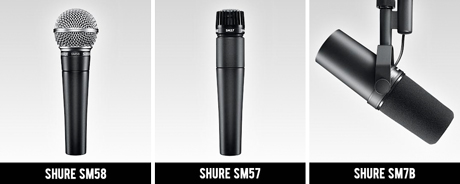
Dynamic mics are considered your typical stage mic. Most concert venues, churches, and so on use dynamic mics because they can handle high pressure sound levels, and they are used when the sound source is close and loud. The most popular dynamic mics are Shure SM58, SM57, and SM7B.

Shure-Mics
www.shure.com

PROs: These mics are fairly inexpensive, rugged, and road-worthy. The sound is pure and focused. They do not require phantom power (48v).

CONs: These mics can produce a nasal sound. They lack some high end (in comparison to condenser mics). They also have a pronounced proximity effect (the closer your source is to the mic, the more enhanced the bass sounds), so some EQ tweaking may be needed depending on the sound you are after.

Condenser Mics

Condenser microphones are the most common types of microphones you’ll find in recording studios. They have a much greater frequency response and transient response (which is the ability to reproduce the “speed” of an instrument or voice). They also generally have a louder output but are much more sensitive to loud sounds.

PROs: Much greater frequency and transient response. A louder output.

CONs: Often more expensive than dynamic mics. They can be very brittle with little low end. They require phantom power (48v). They are very sensitive to loud sounds and may require a pop filter for plosives ‘p’ sounds.

Different Types of Condenser Mics:

Large Diaphragm Microphones – Large diaphragm microphones (LDMs) are generally the choice for studio vocals and any instrument recording where a “deep” sound is desired. A large diaphragm microphone generally warms up the sound of what it’s recording. If using a condenser microphone for vocals, you’ll likely want to use a pop screen; these mics are so sensitive to transient noises that the “P” and “SH” sounds you make will cause distortion.

Small Diaphragm Microphones – Small diaphragm microphones (SDMs) are generally the best choice where you want a solid, wide frequency response and the best transient response, which, as we mentioned before, is the ability for your microphone to reproduce fast sounds (such as stringed instruments).

Good condenser microphones include the Audio Technica 2035, Oktava MC012 ($99), RODE NT1 ($199), and AKG C414B ($700)

www.audio-technica.com • www.oktava.com • www.rode.com • www.sweetwater.com

Once you have decided on the type of mic you are going to use, let’s go over mic positioning.

Mic Positioning

Recording Guitar and Vocals With One Microphone

Try to position the mic far enough away to capture the voice and guitar, but not so far that you capture the room sound. This is going to take some testing of various mic positions for the sound you want. Again, use your ears for best judgment.

As important as proper placement is, it’s even more important to use a mic with the right pattern. A cardiod mic in this scenario may work well because they reject sound from the rear. On the other hand, omni mics have a figure 8 pattern, which means they pick up sound from the front and rear of the capsule.

Recording Guitar and Vocals With Two Mics

If you’re using a large‑diaphragm condenser, you can achieve a useful improvement in the amount of separation by switching from cardioid pattern (where the null is behind the mic) to figure‑8 (where the null is perpendicular to the plane of the mic, and much deeper than in cardioid). How does this help? Using a figure 8 pattern or omni mic means that the null point will cancel the other mic out of its pickup. You may still have some spill, but you won’t have as much of a phasing nightmare.

Microphone Applications

Acoustic Guitar

A small diaphragm cardioid condenser is preferable here. As a starting point, aim it down so it’s looking at the 12th fret, and set it about 6-8 inches away.

Large diaphragm condensers can also work nicely on acoustic guitars, as well as ribbon mics. Have fun experimenting with different mics and placements to find what works best for you.

Vocals

When it comes time to overdub vocals, you’ll want a large diaphragm condenser mic. For a lead vocal, you should match the mic to the vocalist, who may have a personal mic preference.


As you can see, there are different techniques for different mics for different applications. There really is no standard setup. As I always tell musicians and engineers, use your ears to find out which mic and setup produces the sound you want.


Leave a comment
...Keep Reading