



















Source Local

Writing Better Songs: How to Silence the Inner Critic

By NationWide Source Estimated reading time: 5 minutes

You’ve sat down with your instrument of choice. You had a moment of inspiration, and the chorus to your next hit comes rushing out of you. You start to work on the first verse, and all of a sudden-nothing. All your lyrical inspiration is gone, the melodies won’t come–you’ve got nothing. In an instant your great spurt of inspiration is completely used up.

And in less time than it takes to microwave a hot pocket, you are convinced that this is the worst thing you’ve ever written. You’ve decided that every song you’ve crafted is trash. You are going to turn in your resignation as a artist, and never play your music in front of people again.

While this example may be a bit of a stretch, most songwriters hit this wall eventually. Something negative happens, and you become highly critical of your own work. Self-criticism can be a good thing when it comes time to edit a song, but when you are trying to get into the zone and create, this critic does more harm than good.

So how can you turn off your inner critic and let your creative juices flow?

Quantity, not Quality

One of the best ways to shut down the harsh voice in your head is simply by writing more songs. Cultivating an environment where you can just be yourself helps takes some of the pressure off the writing process.

Here are some steps you can take to begin this process:

  • Have concrete writing goals. Set a realistic weekly number of songs to write, and commit to finishing them.
  • Battle your fear of failing. There is a good chance most of the songs you write will be bad. That’s okay. Allowing your self the freedom to write some bad songs will help you know when you’ve written a great one.
  • Remember, this is a no pressure situation. You don’t have to play these songs for anyone. After you write them, you don’t even have to play them for yourself!
  • Push through when you hit a wall. This is the key to making this strategy work. Fight through the temptation to quit, and finish the song.
  • Create for creation’s sake. You may find that the more you write, the quieter your self-critic becomes.

This kind of writing may be difficult at first. That’s okay. Stick to your goals, and write anyway. Churning out material, no matter the quality, gets the creative part of your brain working. When the creative voice is louder, you may find that the inner critic’s voice is so small you can barely hear it.

Write. Just Write.

Music is not the only form of creative expression. If you are having a particular problem coming up with lyrics, it is a good idea to just write.

Writing can take many forms, but the first exercise I recommend is keeping a “First Thoughts” journal. Keep a notebook and pencil next to your bed, and every morning, write for 10 minutes. Do this before you do anything else.

The most important rule of this journal is that you are not allowed any kind of filter. For 10 minutes, write down your thoughts exactly as they come into your head, with no editing. Grammar doesn’t matter, punctuation doesn’t matter, you don’t have to make any kind of sense. (Mine never do, since I don’t make any sense before I’ve had my morning coffee!) You can write your dreams, what you want to accomplish that day,  what made you angry last night, or a play-by-play recap of your favorite reality TV show.

It doesn’t matter. Just write.

This strategy turns off the critic by turning off all filters. Then, in other writings, you can put those filters back in place as you need them.

Your “First Thoughts” journal shouldn’t be your only writing. Try your hand a writing a blog. Or write an incredibly detailed description of a simple object. Dabble in poetry. Do whatever it takes to loosen up the pressure of putting words down on a page. Experimenting with other writing forms can also open you up to different approaches to songwriting, and can help you find new inspiration.

Identify the Critic

This may take a little time, and a little soul searching. Often, the critic inside of us is not really us. It is an outside voice that we have taken on. This may be the voice of a teacher who spoke harshly about your work. It might be a parent or close relative that scoffs at your music when you share it. Your self-critic might not even have its roots in music, but in something else in your life that translates to criticizing your creative self-expression. This voice is different for everyone, but identifying it can help you fight it.

Once you’ve identified the voice of your critic, address it. Write a letter to it, or a song about it. It doesn’t have to be an eloquent letter, or a fantastic song. It just needs to be honest.

As a creative, part of what allows you to make good art is your ability to be in touch with your emotion. This is especially true when things  are painful. It’s not an easy task to identify the critic, or to firmly tell them to please be quiet. When you have acknowledged the hurt that they caused, and the affect that you allowed that hurt have on your life—specifically your music—you can begin to move on from it.

Don’t Be Afraid to Play

When our self-critic says we’re not good enough, sometimes we just have to get out there and prove it wrong. Don’t be afraid to share your music. Try a new song at your next show. Play a short set for your closest friends. Send your mom your latest demo. Show yourself that you are not limited by what your self-critic says.

More Than the Music

The last, and probably most important step into turning off the self-critic is to remember that you are more than your music. You are more than a collection of notes, or a few lines of lyrics. Your songs are a part of who you are, but they don’t define you.


...Keep Reading

Improving Your Live Show: What Should You Do In Between Songs?

By NationWide Source Estimated reading time: 7 minutes

I curled up in the coffee shop’s armchair, took a sip from the mug in my hand, and looked around. The coffee shop was busy. In all honesty, it’s as much a venue as it is coffee shop; it has live music daily, a permanent stage and nice sound system, and a loyal group of customers who frequent the establishment to get their fix—both of caffeine and music.

On this particular evening, I was one of those customers. I was there to spend my evening with a few good friends and discover some (hopefully) good music. While I was there for the music, I did not know who would be playing.

As the artist took the stage and began to play his first song, I was pleasantly surprised. It was clear that he was talented and knew what he was doing, and you could tell he had spent countless hours writing and rehearsing the song. He quickly had my full attention.

The first song ended, and he launched into his second song. It was still good—all the key musical elements from the first song were in place—but my thoughts began to wander. By the third song I was occasionally whispering to my friends, and, by the fourth, I was ready for something new.

My fleeting interest had nothing to do with his musical ability. His songs were interesting, and he knew them well. I truly enjoyed the music. But, his performance didn’t catch and hold my interest. This bothered me. As someone who wants independent musicians to succeed, and as someone who is willing to support them in their efforts, I was disheartened.  What went wrong?

I realized that sometimes music alone isn’t enough to grab and keep a potential fan’s attention.  Sometimes, you have to entertain them.

Not Just the Music

As a general rule, all musicians—even the most reclusive artists—must perform in front of people, at least occasionally.  Live performances (and their accompanying merch sales) account for a huge percentage of income for today’s independent artists, and they are the best opportunity to make new fans and cement ties to old fans.

Many new or inexperienced musicians think that playing a successful show means getting in front of people and simply playing their music with minimal mistakes. They might tell a few stories, say a few song names, and introduce the band… or they might not. There is no “rest of the set” to plan, since they count on the music to carry their performance. To them, the music is all that matters.

And they aren’t wrong… Your music needs to be awesome. You need to spend hours rehearsing, getting to know each note so well that you could play your whole set in your sleep. That is a vital piece of the puzzle. It is huge piece of the puzzle.

But… it’s just one piece of the puzzle. Yes, great music can reel a person in. Yes, beautiful art can keep them engaged for your entire performance. But just because it can, doesn’t mean it will. Chances are, the majority of people you’re going to be playing in front of need more.

In today’s economy of short attention spans, 140 character updates, viral videos, and entire worlds on devices in every person’s hand or pocket, musicians face more performance challenges than ever before.  There are going to be other things happening during your performance, even in the best listening rooms.  So, how do you compete with the hundreds of distractions waiting to steal the focus off of your performance? You give them a great show.

Putting Together a Great Show

If you’ve ever been in a musical, you know that there is an order to the procedure.

  1. Make sure the music is great—each note should be perfect.
  2. When the music is nearly perfect, everyone starts learning the script. This includes the performers who don’t have lines; they still need to know exactly what’s going on.
  3. Once the music and lines are learned, the group comes together to work on blocking (the movement of and transitions between) each scene.

Without the music, there isn’t a musical. Without the lines and proper sequence, there’s no story. It’s nothing more than a collection of songs. Without the blocking, it’s disjointed and bumpy at best. At worst, it fails to capture the audience’s attention.

Why am I telling you this? Because your live show is not much different than a musical.

Creating A Pseudo Script

In a musical, the script dictates everything that goes on onstage. As an independent musician, though, you get to write your own script. You get to decide what goes on in your live shows. Your script includes what you say (and choose not to say) between songs, but it is more than that.

Your script starts with a set list. The right song order is incredibly important, whether you’re playing 30 songs or two songs. If you’re not sure where to start with creating a set list, you can read the article we recently wrote about it here.

The second part of your script is what you say in between songs. If you have original songs with particularly interesting stories behind them, you might tell those stories before starting the songs. You can introduce yourself and the band, talk about your latest release, or share funny stories from the road or past performances. The possibilities are limited only by your imagination. After all, this is your script and your show.

Put It Into Practice

A good show starts in rehearsal. You should be used to rehearsing your music, but it’s also important to rehearse your script. You should practice your songs in the order you want to play them at the show and practice the stories you will tell to take your audience from one song to the next. This will help your whole set be cohesive.

As you begin to rehearse and use your script, you will probably find that some ideas work better than others. Some stories make your audience sit up and listen to your song, while others make them turn to their friends to have a conversation. Discovering the right stories, the right balance between talking and music, the right balance between types of transitions, and the right way of talking to your audience are all things that take time and practice to figure out.

If you play with a band, they will probably be able to help you filter some of what will and won’t work. Ask for their honest opinions, and use your bandmates as a sounding board for other ideas you may have.

You can also try filming your rehearsal, script and all, and watching it back. Does your speaking voice sound natural? Do the songs make sense in the order you’re playing them in? Are you stumbling over parts of a story? Does the show have musical variety? You are usually your harshest critic; watching yourself can help you pinpoint the areas you need to work on.

After you’ve done some internal editing, ask your friends and family if you can play a house show for them. Ask them to give you honest feedback when the show is over. This can be a great tool to practice interacting with your audience with people who are excited to see you succeed. It will let you know where a punch line falls flat or where you may need to add or take away parts of what you will say. Trial and error is the best way to get your script exactly where it needs to be. Don’t worry if you don’t hit the ball out of the park on your first time up at bat.

Although it is necessary to know what you will say, and to practice incorporating your script into your set, don’t be afraid to change it on the fly. Every show is different, and every audience needs something in your show to make it personal for them. Don’t be afraid to try something new. It might not help… or it might take your show to new heights!

Live performance is an art unto itself, and the script is only half of what makes a live show great. Check back soon to learn how to capture your audience’s attention by creating a visually interesting live show.


...Keep Reading

Apple Music Streaming: What It Means for the Independent Artist

By NationWide Source Estimated reading time: 5 minutes

Yesterday, Apple unveiled its new music streaming service. While Apple’s release of iTunes revolutionized how the world buys music, they have been slow to enter the world of streaming.

The announcement came with all the bells and whistles that normally accompany Apple’s tech releases… but, for independent musicians, the announcement likely raises more questions than it answers.

The Basics

For the new service, Apple will charge $9.99 per month for streaming and radio services. Alternatively, users can choose a family plan (for up to six people) for $14.99 a month. Apple Music streaming will offer curated playlists, radio stations, complete integration with iTunes, and a new artist-to-fan social feature called Connect.

What Will It Pay?

Noticeably absent from all information offered by Apple is the amount that Apple Music will pay artists.

Unlike other streaming platforms, there is no free tier on Apple music. This is good news for the makers of music, as it should increase the amount of money paid to rights owners. However, if the payment structure looks anything like those of Spotify or Pandora, independent musicians will still be getting the smallest piece of a very small pie. The music streaming industry as a whole is not friendly to independent musicians.

It appears that Apple Music will not be much different, despite their claims in the announcement videos to help independent musicians build sustainable careers.

Will “Connect” Actually Connect Artists and Fans?

It seems that Apple Music is trying to compete with Jay Z’s Tidal by offering fans exclusive content at no extra cost. Actually, they are offering “exclusive” content at no cost at all. Anyone— even nonmembers of the streaming service—can access the videos, pictures, and music files that artists upload. This is not good news for independent musicians.

If you are working hard to create exclusive content for your diehard fans, you should be doing it in a way that creates income for you. (Ever heard of patronage?) By making Connect available to everyone, Apple completely negated the “exclusivity” of that content. In essence, it’s the same as putting a video up on YouTube. The key difference is that this content will link directly to your music and artist profile in Apple Music. It’s an important distinction, but it’s not enough. There’s no real way for your content to work for you on Connect.

Apple also did not address royalty payments on Connect. If you upload a demo of your new single, are you being paid whenever fans listen to that demo? Or are you cutting your losses? You spend the time creating a song and recording the demo—not to mention the money you spent on the equipment to do those things—and Apple hasn’t given any indication on whether or not they are going to pay you when fans listen to your “exclusive” content.

Connect also offers nothing new in terms of fan engagement. Fans can comment on the material you upload, and you can comment back. This is exactly what is offered on Facebook and Twitter. Connect is a downgrade when you look at its social media competition (Twitter and Facebook); even Spotify allows private messaging. The only benefit in Connect is that fans don’t have to follow you to see your content and comment on it.

Independent Friendly?

Did I mention that there is a MAJOR problem for independent musicians in the very structure of Apple’s Connect? As an independent artist myself, with music currently on iTunes, I decided to claim my Artist profile on Connect. This is what I found:

Screen Shot 2015-06-09 at 9.49.00 AM

I am a fully independent artist with no management company or label. Normally, I would just submit my information the management information and leave the label portion blank, since I am not signed to any kind of label. However, there was no option to communicate that I was not affiliated at all with a record label. I was not able to push the submit button to claim my profile until I had entered information about my (nonexistent) record label.  If Apple is touting that their service is indie-friendly, requiring artists to enter their record label information in order to claim their profile is not the way to go about it.

So far, I have seen nothing about Apple Music that is truly attempting to help independent artists.

What Should Independent Artists Do?

Apple Music’s launch simply adds to the ongoing discussion about streaming and its sustainability. Streaming is great for fans of music, but is this form of music consumption beneficial to the music industry in the long run? How can artists create long-term careers when their sources of income are decreasing in number and scale?

Independent artists have to change the way they think about streaming as a whole. When you look at streaming as a revenue stream, it falls short. No one (not even Pharrell) can make a living purely from the income generated by streaming. It simply isn’t generating enough money.

However, when artists look at streaming as a marketing tool that pays them, the game changes.

If you want people to discover you using streaming services, great! Put your music on Spotify, and Pandora, and Apple Music. Just don’t add your full catalog. Let fans get a taste of your best stuff. Post on Apple’s Connect like you would any other social media tool. Just don’t let these third party websites be the primary way that you interact with and sell music to fans. There are other, better ways to connect with the people who love your music.

In the End

Is Apple streaming a game changer for the music industry? I don’t think so. At the moment, it appears to be nothing more than a company formerly on the leading edge of innovation playing catch-up. Apple Music is not going to revolutionize the music industry.

Instead, changes and revolution will come from independent artists and the choices that we make as content creators.

For more information on Apple Music, check the following websites:


...Keep Reading

Creating a Strong Profile on Pinterest

By NationWide Source Estimated reading time: 8 minutes

So you think that Pinterest might be a good tool to keep in your proverbial marketing tool belt? Great!

Let’s get into the practical ways you can effectively use Pinterest to connect with fans and increase traffic on your website.

Creating Your Profile

The first step is to sign up for a Pinterest Account. There are now two types of Pinterest accounts: personal and business. The business accounts operate exactly like personal Pinterest accounts, except you get free access to analytics. This is a valuable tool once you learn how to use it, so I recommend signing up as a business account. If you already have a personal Pinterest account, you can convert it into a business account. However, unless everyone and everything connected to your personal account fits with your brand as an artist, I recommend that you keep your personal and business accounts separate.

Screen Shot 2015-05-29 at 10.19.21 AM

After you sign up, you will confirm your account through email.

Once your account has been confirmed, you will need to edit your general profile information. To do so:

  • Click on your user name in the top right to get to your profile.
  • Click the “edit profile” button just below your name.
  • Upload a profile picture. The picture should be in focus and not pixelated, easily identifiable, and tied to your brand as an artist. This lets followers instantly recognize a pin as yours.
  • Add a link to your website. This is important, as you are on Pinterest for marketing purposes. Without this link, people who discover you through Pinterest have no easy way of finding out more about you.
  • Choose a custom domain for your Pinterest account. Consistency is key, so try to keep your custom domain as close to your name, website, or other social media custom domains as possible. 

basic info

And that’s it! Your profile is created. Now, let’s make it a strong profile! How do you do that? You add content… the right content.

Building Your Boards

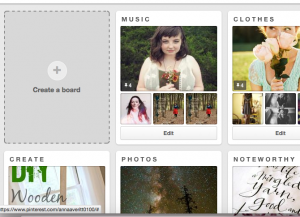
After you’ve edited your basic information, you should begin to create boards. To create a board, simply go to your profile page and click on the “Create Board” icon on the left.

Screen Shot 2015-05-29 at 10.13.11 AM

Your boards are where you will pin your content. Topical boards are the best way to organize your content (this is helpful when people are browsing your pins to find content or learn more about you).

When creating your boards, it’s important to think ahead to the content you will pin on them. It’s also important to keep this mantra in mind: Get personal.

You’re here to genuinely connect with fans through shared interests and to give them a glimpse of who you truly are. If all you do is promote yourself, you have missed out on the most useful parts of Pinterest. Your pins, therefore, should reflect who you are as much as (if not more than) what you do.

The key is to strike the right balance.

For boards reflecting your personal interests, some good ideas (topics that consistently trend on Pinterest) are recipes, fashion, DIY projects, and art. If you’re personally interested in something, create a board around that topic.

In terms of boards for marketing your music, you can create boards for your music and videos, tour posters, promotional pictures, live shows, pictures with fans… pretty much anything that can be translated into a visual medium, you can create a board for.

You can (and should!) also have boards that tread the line between your music and personal tastes. Create a board that shows your fans the inspiration behind your music; it could include quotes, poetry, art, or photography. You can even create inspiration boards for specific release, whether a whole album, a single, or a music video.

You can also create shared boards that your fans can pin to. Want to know what your music inspires your fans to do or create? Create a board for fan art. Not sure what to wear for your next music video or photo shoot? Ask your followers! Not only will you get great ideas, but since they were engaged with planning, they will be more likely to share the finished product.

Katy Perry’s page is a good example of fan interaction. Many of her boards allow fans to pin their own content to them. This helps her fans to feel like they are involved with Katy on a personal level. However, Katy’s profile is mostly self-promotion, which is not the way we recommend independent artists use Pinterest. Personal and authentic content is the best way to add and keep followers.

Branding Your Boards

Your personal branding doesn’t have to stop at your website or your profile picture. Pinterest allows for a lot of flexibility and customization. You can create boards around any theme you want, you can name the boards whatever you want, and you can set the main image for each board. Play around with this to tie in your existing branding.

Actress/Pop Singer Vanessa Hudgens does a really good job of consistently branding her boards. Her board titles are simple, and she has uploaded a custom cover photo for each board using the same font and style.

vanessa hudgens boards

Adding Pins to Your Boards

Your content on Pinterest is the point of connection between you and your fans, so make sure that it is well thought out. Remember that people follow you because they are interested in who you are. Show them that with your content.

You can do this with a good mix of original content and repins. If you blog regularly, pin the images from your blog posts. Repin recipes of what you want to eat for dinner alongside an original pin of your new music video. Pin tips for caring for a sore throat and maintaining health; after all, you as a singer should know how to care for your voice. If you’re a coffee connoisseur, re-pin recipes you want to try alongside photos of drinks from coffee shops you visited on the road.

One benefit to pinning original content is that it gives you greater opportunity to drive traffic back to your website. (Pinterest is well-known for its click-through rate.) This works best if you pin directly from your website or point people back your website, where they can buy your music or a T-shirt or get signed up for your mailing list. You can also pin from your other social media accounts. This isn’t as ideal as sending traffic directly to your site, but it could increase your opportunities to interact with your fans. We mentioned Vanessa Hudgens for her branding earlier, but she also does a great job of directing the traffic back to her.

You should also brand your original content. If you have a logo, place that logo somewhere unobtrusive in the picture you’re sharing. That way, even if the link to your original page gets lost, people still know where the content they liked came from.

If you are repinning content that others uploaded, be conscious of what you are pinning. Respect other people’s work. Just like you don’t want someone else to get credit for your songs, a food blogger doesn’t want someone else to get credit for the chocolate cake recipe they worked hard to create. Make sure the picture or recipe links back to the site where it originated. Also be sure that the creator is open to having their content pinned (i.e., look for a “Pin This” prompt on their website or for original pins they have uploaded directly). We’ll use Vanessa Hudgens as an example again. On her Music board, almost all the content is pinned directly from the artist’s website or social media accounts. This drives the traffic back to those artist, giving them credit for their original content. When used correctly, Pinterest is  great way to cross promote, and other independent business will likely be grateful for your appreciation of their content.

Adding Quality Content

Pinterest is primarily a visual medium. Good images are key to increasing engagement. Text should be legible. Photographs shouldn’t be out of focus or pixelated, and they should be well-lit and visually interesting. What does this look like in practice? Instead of pinning a photo of your new merch shirt on a hanger or sitting in the box, ask a friend or fan to model it… but go to a pretty location with good lighting (often indirect lighting) instead of your garage or spare bedroom. Got a new album coming out? Take your favorite line or two and turn them into a gorgeous graphic. If you like it enough, it might be something you turn into an art print to sell as merch!

On a side note: make sure that when you are creating these graphics, that you are not using copyrighted material. You can gets lots of great stock photos at decent prices from sites like fotolia.com and Shutter Stock. Or, if you have a photographer or graphic designer friend, ask if they want to collaborate and make graphics that both of you can use.


...Keep Reading

Crafting a Set List: Your First Step to a Great Gig

By NationWide Source Estimated reading time: 9 minutes

You’ve gotten THE gig, and you’re super excited. You’ve been rehearsing, but now you’ve kicked rehearsals up a notch or twelve. You’ve also come to the place that most musicians dread but every musician must deal with: You have to make a set list.

Some bands don’t bother with set lists, but they are important. Why? A bad set list can ruin a show. A good set list can take a decent band and make it sound like a good band. A great set list can reel a listener in, keep them with you for the entire show, and win you new fans.

There are many different things to consider when creating a set list, but we are going to focus on five key elements for creating and using your set list to its fullest potential. These five elements are:

  • Purpose/Audience
  • The Technical Stuff
  • The “Feel” of the Song
  • Transitions
  • The Art of Spontaneity

The Basics

Before we send you off into the world of set list creating, we should go over a few basic concepts.

  • For the purposes of this article, a “set” is going to be 12 songs. Depending on your songs and what kind of set you are playing, this number will vary, and that’s okay. Once you’ve looked at the five key elements of creating a set list, and you know how much time you’ll have for your set, you can adjust your number accordingly.
  • Generally, a good set is divided into three or four parts, with each part having its own peaks and valleys. Let’s call them “set-sections.” The number of set-sections you will have will depend on the length of your set, but even a two song set needs to have contrast within it.
  • Not all sets will look the same. You may have a gig where it’s appropriate to play an album in its entirety. Or, you may have a gig where you only play covers. These rules are not one size fits all. Don’t be afraid to experiment and fit the set to the gig, whatever that may look like.

Now let’s look at what you can do to craft a great set list.

Purpose and Audience

When you create a set list, you need to determine the purpose of your set.

The first consideration is the setting or venue. A set for a coffeehouse will probably look different from what you would play at a wedding, and a wedding set list will look nothing like a set for a summer festival. The venue itself will help determine some of your decisions—a small stage with only enough room for two people might not be the best time to play a song that sounds best with your full band.

The second, and perhaps most important, consideration is the audience. At each of the places I mentioned above, the audience will react to you in very different ways. This is why you should create your set list with your audience in mind. They are, after all, the people who are (hopefully) paying to see you. If you are in a small room and people are paying attention, it might be all right to bust out the B-side from your second release that no one but your mom has heard. But, at a busy festival or in a crowded bar, you may want to play songs that are known attention-grabbers or fan favorites that have stood the test of time.

When you have a general idea of the audience you will be playing for, you have another factor to consider: How do you want the audience to respond? You are onstage and have a microphone to carry your voice across the murmur of the crowd. People will be listening to you, even if it’s only for a moment. There is some authority, however small it may be, that comes with your position. Do you want your audience to get up and have a good time? Great! Plan your set so they can get up and dance, and give them a couple slow songs to grab a drink.  You want to raise awareness for your favorite cause? Use your music to put people in a frame of mind that will allow them listen to you when you talk about that charity. You can’t force people’s responses, but if you have a purpose for your set, you can help guide your audience in the direction you want them to go.

The Technical Stuff

Okay, so you’ve identified your setting, your audience, and your purpose. Now it’s time to get into the nitty gritty of creating your list. There are a few rules to keep in mind that deal with the details of your songs.

Key

Though the average listener might not know what key you’re playing in, if you play too many songs in the same key consecutively, the audience will likely think everything sounded the same and lose interest—even if the songs have different tempos and a different feel.  A good rule of thumb is to never play more than two songs in a row that are in the same key.

Tempo

As with key, it makes a difference to vary the tempo within your set list. Try to categorize your songs into slow (60-80 BPM), mid-tempo (80-110 BPM), and fast (110 BPM and above). Then, in each of your set-sections, try to have a variety of tempos. You can also group tempos or have one slow set-section that has some tempo variation with its broader “slow” category. Maybe try slow-mid-slow in one section, or come way down and do a slow-slow-mid and ramp back up into a more energetic set-section. This variety keeps your audience from losing interest.

Complexity and Energy

If your drummer has gone crazy playing over 140 BPM for the last set-section, you may want to slow down a little bit and give his muscles a break. Really, it’s the same no matter what instrument you play.  The lead singer may enjoy nailing those difficult high notes, but—if you don’t bring it back to their comfort range—their voice will begin to tire, and your sound may suffer. Try to keep your more challenging numbers separated to give you and your band a break. Bring them back in when you need to re-capture your audience.

The “Feel” of the Song

In the same way that you don’t want too many songs in the same key played together, you also want to pay attention to the “feel” of the song. Though the term “feel” is subjective, there are a few concrete things we can look at.

Rhythm

Is the song shuffled? Does it have more of a dance beat? Are all the choruses played half-time? Try to separate rhythmically similar songs, or only play two back to back.

Timbre

In the same way that you can tell the difference between a flute and a trumpet, your lead singer’s voice has different timbres, or sounds, that fit together in different ways. Likewise, you can switch effects on an electric guitar or switch to an acoustic guitar to further vary the timbre of your set. Keep these differences in mind from song to song, and use timbre as a way to bring diversity to your set. By experimenting with timbre in a set-section, you may create a whole new feel that you and your band love.

Mix in these experiments with a tried-and-true song to keep your audience engaged.

Transitions

It’s important to consider how you are going to get from one song to another. Are you going to tell a story? Introduce your bandmates? Go straight from one song to the next? Planning your transitions will help your show run smoothly.

Transitions are also the main distinguishing factor between an amateur musician and a professional career musician.

Practical Tips:

  • Know who is going to start the song. Is you drummer counting off? Is the guitarist starting out with a riff? Assigning responsibility for the start of the song lets everyone be on the same page and helps eliminate empty time between songs.
  • Have an instrument play behind spoken transitions. This prepares your audience and your band for what’s happening next. It also adds sonic interest to the story.
  • Carefully craft a musical transition between songs. This can be difficult, but, when done well, it can impress your audience and keep them engaged with what’s happening onstage. It’s best to do this with songs that are in related keys. For example, if your current song is in C, and the next song is in G, a musical transition will work well since G is the dominant chord in the key of C.

The Art of Spontaneity

It’s important to have a plan for your set and transitions as you prepare for your show. But what happens when life throws a curve ball your direction? Perhaps your audience isn’t paying attention to your well-crafted set, or the sound man gives you a 10 minute warning 20 minutes from your big ending. What do you do then?

When a wrench gets thrown in the works (because sooner or later it will happen), you don’t have to be afraid IF you have rehearsed well. Being unprepared when challenges arise is when real problems begin. Knowing your whole set so well that you could play it in your sleep helps you recover quickly when things don’t go as planned.

If the audience isn’t listening the way you would like them to, try rearranging your set-sections or the individual songs in those sections. If you have to cut your set short, know what you want to eliminate and where you want to pick back up.

You may even find that a change in your set leads to something marvelous. If you forget a song in the middle of the set, you might find that the audience actually responds better without that song.

I can promise you that you will have problems, but they only stay problems when you don’t learn from them. If you can recover well and take stock of what happened, those problems become opportunities for you to play an even better show next time.

Creating a great set list is a skill that takes practice and lots of trial and error. The more shows you play, the better your sets will be. Don’t be afraid to get out there and try different sets, but pay attention to people’s reactions. Figure out what works for you, and you will be on your way to having a great live show.


...Keep Reading

Finding New Fans: Why You Should Be On Pinterest

By NationWide Source Estimated reading time: 6 minutes

I have an idea of what you might be thinking: Pinterest? For my music? Isn’t Pinterest for girls planning their weddings?

As a musician, using Pinterest for your band may sound a little strange, but just give me a minute. There is a chance you are missing out on a great opportunity to market your music.

Pinterest Basics

If you’ve never used Pinterest before, its concept is simple. Users create topical pages called “boards” and add content to their boards by “pinning” pictures, videos, or audio files. Much like bulletin boards of the past, a user’s pins are a mishmash of images from their own life, items they want to purchase, things they want to try, places they want to go, and things that inspire them, spark their creativity, or simply make them happy.

Unlike a private bulletin board, Pinterest is a very social system. You can find and follow other users by searching by name or by linking to your other social media accounts. A user’s pins show up in the home feed of everyone who follows them; likewise, the user can see the pins on boards of users they follow. When following other users, you can follow one of their boards, all of their boards, or only their boards that interest you. Most boards are curated by only their creator, but boards can be shared among multiple users, allowing for easy collaboration on projects. Users can also create private boards, accessible only to their creator. Lastly, users can comment on pins, repin a pin on their own board, and send pins directly to other users.

Pinterest History

Since its creation five years ago, Pinterest has gained millions of users. Its purely visual format is simple, the content is inherently shareable, and it allows users to collaborate easily. What’s not to like?

Pinterest has an interesting—almost niche—user base. About 75% of their users are female, and most users are between the ages of 24 and 34. The most popular topics on the social network are food-related (recipes) and DIY projects. Don’t be fooled, though, into thinking Pinterest can’t be relevant to you or your music. There is a vast array of content. Yes, you can find step-by-step instructions to frosting the perfect cupcake. It’s right there next to tips on turning wood pallets into coffee tables, makeup tutorials, and the fall line for Marc Jacobs, which in turn are mixed in with humorous memes, pretty pictures of handwritten song lyrics, celebrity snapshots, and photographs of classic cars.

Regardless of what they’re looking for, a large portion of Pinterest users choose the site as their go-to search engine. Which makes it a little less surprising that close to 90% of “Pinners” have purchased something that they pinned.

Pinterest for Musicians

For the musician, Pinterest has two main benefits:

Connection

What makes someone really truly love a song? Good melodies help. An interesting phrase can catch someone’s attention. But, chances are, someone loves a song because that song makes them feel understood. Listeners feel like they share an experience or emotion with the artist.

If used correctly, Pinterest can be as helpful in building connections with your fans as your best songs are.

Pinterest is a great way for your fans to get to know you and vice versa. Your customized, topical boards let your fans have a sneak peak into your life. Common interests and tastes may turn a casual listener into a real fan who is ready to support someone they feel close to. Chances are, if they already like the music that you make, they will have some other similar tastes that can be a jumping off point for a strong connection between you and your existing fans.

You can also see the things that your fans like. If a particular style is consistently repinned by your fans, you might think about adding a product with a similar style to your merch table. Tailoring your products to the tastes of the people who will potentially buy those products can mean more merch sold and more money in your pocket.

Pinterest is also a great way to reach new people who might enjoy your music. If you have thoughtful content on the site that interests your followers and prompts them to share it, their networks will see it. If the new viewers are interested and look into the pin (i.e., follow it back to the source), they might discover someone new to follow (you!) and something new to like (your music!).

Conversion

Pinterest is an aspirational website. Its users pin content that reflects something they hope to be, or do, or buy.

Pinterest is also inherently viral. The vast majority of content on Pinterest is “re-pinned,” meaning that people are sharing existing content rather than generating original content. Because of this, pinned content stays around for much longer than a Facebook post or a tweet, and something that you uploaded months ago still has the potential of being repinned.

Lastly, Pinterest is effective at sales conversions. Pinterest beats out other social media platforms in terms of links leading to online purchases. It also has more users click through to the source site than any other social media platform.

What does this mean for bands using Pinterest? A few things:

  • Your content should resonate with fans, genuinely hitting on something they hope to be, do, or buy.
  • Sharing existing content isn’t bad, but uploading original content is better. With original content, you can link to content on your website, driving traffic back there. You can’t really do that with someone else’s images, video, or audio. Additionally, original content is something that your followers haven’t likely seen before… which means they haven’t already pinned it and can do exactly that.
  • Your profile should link to your website. That way, anyone curious about who exactly is pinning this amazing content has a way to find out more.

Keep the above in mind with pinning, and you will likely see your website’s traffic and your sales increase.

As With All Marketing

As with all forms of marketing, the first step is to know your audience. Pinterest isn’t for everyone. If your audience is mostly 55-year-old males, Pinterest probably isn’t the best social media platform to use to market yourself. However, if your target audience is 20 or 30-somethings or largely female, it may well be worth the time it takes for you to establish and run an account.

In the end, you have to be smart about the tools that you use to market yourself and make sure that the time you spend on any marketing endeavor is worth your efforts.

Want to learn more about how to use Pinterest as an effective tool to market your music? Check back later this week for practical tips to build an engaging, effective profile.


...Keep Reading

Music Marketing Strategies

Better Marketing in One Easy Step: Shooting for a Bullseye

By NationWide Source Estimated reading time: 7 minutes

You’ve just spent countless hours revamping your website, following and chatting with fans on social media, and sending a hundred—or was it two hundred—emails to add more bookings and press to your schedule. Your eyes are red and itchy, your fingers are beginning to cramp, and when you look away from your screen you can hardly see straight. It’s time to stop for the night.

And what do you have to show for all that hard work? A few new followers, some extra likes, three automated e-mail responses from people who are on vacation… but no real results.

This is a dismal story, but it’s one I hear too often. Musicians, working hard to market themselves, are not getting any real return from that work. It helps to know what marketing is.

What Exactly Is Marketing?

Marketing is a term that gets tossed around often but can be hard to grasp, especially for musicians. Merriam-Webster says that marketing is “the act or process of selling or purchasing,” and “the technique of promoting, selling, and distributing a product or service.”

To put it simply: Marketing is the work and the strategy of selling something.

All businesses use marketing in some form or another. TV commercials, junk emails, a tweet, and a flyer tucked under a windshield wiper are simple examples of what marketing looks like on the surface. But there’s more to marketing than the public message. Behind those advertisements are people measuring the effectiveness of the ads. They are tracking views, shares, and traffic and pinpointing exactly which ads and strategies are increasing sales. Then, they take that information and use it to create more sales.

So with these definitions and examples in mind, have you actually been marketing? Or just keeping yourself busy?

Marketing 101

There are many different ways to market yourself, and everyone has an opinion on what works best. But it all boils down to this:

Good marketing means tangible results.

I could stand in a forest for a thousand hours, paint myself green, and glue sticks to my arms, but it will never make me a tree. It’s the same story for musicians and all the hard work they put into marketing. If you aren’t getting results, you aren’t actually marketing.

But what exactly are results? To measure results, we have to have goals. To have relevant goals, we need to know what our customers need and want. To fulfill those needs, we need to have products.

Product

As a musician, you probably think you have an idea about what your product is: your music. The songs you create and record are your signature product. Your music is what people are going to remember you for and what they are going to purchase from you. However, the music that people consume in various forms—physical CDs, digital downloads, live performances, etc.—is merely one facet of what you are actually attempting to market.

Music isn’t your only product. It isn’t even your best product. You are your best product! As an independent musician, you aren’t just selling CDs or tickets to shows. You are selling the brand you’ve created around yourself and your music and the entertainment that brand offers to your customers.

While there are countless other products you can offer, it all comes back to you as an entertainer. If no one wants you and the brand you’ve built, they won’t want your music and events and merch.

Customers

So if you are your product/service, who is your customer?

Many musicians make the mistake of limiting their customer base to people who listen to their music. In reality, it’s much broader. Anyone who buys anything from you or pays you for a service is your customer. This means that listeners are your customers, but so are venues, record labels, publishers, licensing companies, concert-goers, and so on.

With each new type of customer, you have the opportunity to create a marketing plan that will effectively reach them. Creating a marketing strategy around a known customer tends to result in more effective marketing.

Goals

So we know what you are selling, and we know whom you are selling it to. Now you have to set goals to get those sales.

Though income may be your ultimate goal, there are also different goals you can set that, while they don’t lead to an instant payoff, can add up to income over time. This type of goal could be fan interaction, like signing a certain number of people up for a mailing list, or getting a new video shared. It could also be a networking goal (meeting someone from a certain music blog) or a creative goal (writing a set amount of new material by a deadline). Your goal could be something as simple as the number of CDs you want to sell at your next show, or it could be landing an important gig. These goals involve you actively doing something to generate more income.

Practical Strategies: Work Smarter, Not Harder

So now that you’ve discovered the three most important things to consider as you market your music, it’s time to stop. Take 5 minutes and write down 3 goals that you want to accomplish and a time line for accomplishing them. Got your timer set? Good. When you finish writing down your goals, keep reading to find out how you can make those goals reality.

Ready, set… go!

All done? Great. Let’s get marketing.

Step 1: Target

Want me to clue you into a little secret? This is the only step. Target the things that are working for you, and spend the most time on those things.

Say for example you’ve posted every day this week on Facebook. But just one of those posts—a video—had significant interaction. So the next week, you create another video, and post it to Facebook, alongside your other posts. Again, this video was shared, liked, and commented on. The next week, you decide to post another video exclusively on your website. Since your fans already know they like your videos, they are more likely to click to your website to watch. One you have them on your website, you can get more information about them, like their email or phone number, so that you can have even more interaction with them. This interaction can lead to music sales or to fans coming out to see you live, and those sales means money in your pocket.

This is a specific example, but the principle is the same no matter what your goals are. Find out what works with your customers, and do more of that.

Don’t be afraid to try experiment a little. Go all scientific method on this marketing thing. Set up a time frame, and try different ways of doing things until you find one that works. This goes for social media, for your website, even for face-to-face interaction with fans and industry contacts.

You want to make your live shows more effective? Book some small gigs and take some risks. Play music for 95% of the gig. At the next show, maybe tell a story between each song. Try different ways of talking about your latest project or the awesome new t-shirt you have for sale. Find what works for you and for the people who are listening to your music.

I’m not saying totally eliminate other things that don’t work as well. Variety is not a bad thing. Just make sure that the things that don’t work as well aren’t taking up much of your time. Don’t get so settled into a routine that you don’t try other things that could work for you, or ignore when your current success becomes a little less relevant. Having varied content helps keep fans interested long term, but your time is too valuable a resource to spend on things that aren’t going to help you meet your goals.

Marketing your music and reaching goals doesn’t have to be a mystery. Be creative, target the things that will get the results you want, and work hard.


...Keep Reading

How Much Does Pandora Pay Artists?

How Much Does Pandora Pay Artists?

By NationWide Source Estimated reading time: 5 minutes

It’s probably much less than you think. And if Pandora has its way, that paycheck is about to get even smaller.

Last week, Pandora was given approval to purchase KXMZ-FM, a terrestrial radio station in Rapid City, South Dakota. They are now under a 90-day trial period before the purchase becomes final. Currently, Pandora has millions of online subscribers who create customized stations based on their own music preferences, so their purchase of a small station in a city of 60,000 people may seem like a move backwards, but it’s a strategic move by Pandora to make more money.

Unfortunately, Pandora’s move to line their pockets means a significant pay cut for the artists and songwriters who make Pandora’s business possible.

How Artists Are Paid

The ways that radio and streaming services pay artists are a complicated mess of numbers and percentages, but it all boils down to this: terrestrial radio stations pay a lower rate than internet stations to play the same songs over the internet.

With Pandora’s current rate system, if you are the writer and performer of the song, you will make about $1.30 if your song is played 1000 times. Unless you are Katy Perry or Drake, you probably won’t even make enough money to buy yourself lunch. It would take years for the average independent musician to simply break even on the costs of producing and distributing their music with the payments that are currently made for streaming music.

With their purchase of KXMZ, Pandora will be eligible for the lower rate currently available for terrestrial radio stations. This means they will be paying about a half-million dollars less in royalties to songwriters every year. Pandora’s purchase of KXMZ is great news for Pandora’s stockholders, but no matter which way you look at it, it’s bad news for the artists, performers, and musicians who make business possible for Pandora.

What This Means For Musicians and the Music Industry

In the larger view of Pandora’s profits, the reduced royalty rate is a drop in the bucket. But even a drop makes a ripple in the bigger scheme of what is currently going on in the music industry. Pandora claims that they value the artists who make their company function, but according to the American Society of Composers, Authors, and Producers (ASCAP), their purchase of KXMZ is “a transparent ploy squarely aimed at paying songwriters even less for online music streams.”

It’s worth noting that Pandora is not the first company to take advantage of this lower rate. iHeartRadio works in the same way that Pandora does, but iHeartRadio is owned by Clear Channel, an industry giant in terrestrial radio. Because of this, iHeartRadio can take advantage of the lower streaming rates. Pandora’s purchase of an FM station levels the playing field between these two competitors, and it’s likely that other internet radio and streaming services will follow in Pandora’s footsteps.

Moreover, the government is looking at decisions like this as it revises copyright laws.

We are in a crossroads in the industry. The payment system for creators is broken, and no one is completely sure when it’s going to be fixed. Though you may think Pandora’s decisions won’t affect you, a company as large as Pandora actively working to compensate creators less is something that everyone in the music industry should be concerned about. And while this change may not have a huge effect on your individual paychecks, the implications of this decision are enormous.

What You Should—and Can—Do

So if you’ve realized that you’re not going to make a million dollars on Pandora, or even enough money to pay your rent, what do you do? Should you just take your music off all streaming platforms and cut your losses?

I think there is a better way. By simply changing your perspective on streaming services, there are ways that independent musicians can make platforms like Pandora work for them.

Instead of thinking about Pandora and Spotify as distribution services, think of them as marketing tools. Listeners use streaming services to discover new music, and you don’t want to cut yourself off from those potential fans. Put a couple of your best songs up—not your entire catalogue—and use it as a way for people to discover your music. Once your music has piqued their interest, they will likely search the internet to see what else you have available.

What Else You Can Do

You’re game for using streaming and online internet to market to new audiences… but how can you turn a casual streamer into a devoted fan? You have to engage them (on your turf) with good content.

Your website is the only place online where you have complete control over what a potential fan sees. Use that control!

Design a website that reflects your music and your brand and makes it easy for your fans to be connected with you. Keep it updated with relevant news and content. Offer a free single in exchange for their email address. Show them how they can become a patron of your music. (Haven’t heard of patronage? Sign up here for more info!) Above all, do not rely on social media and third-party retailers to keep in touch with your fans.

The music industry is changing. Pandora’s purchase of a terrestrial radio station is just a small battle in the grand scheme of an entire industry that is in the process of completely renewing itself. Independent musicians are the future of that industry. Now, more than ever, you have the opportunity to take control over your career. And that is good news.


...Keep Reading

Recording Acoustic Guitar & Vocals

By Damon Mapp Estimated reading time: 5 minutes

Hello again, fellow musicians!

In today’s article, I wanted to tackle recording acoustic guitar with vocals and choosing the right microphones.

Recording Guitar with Vocals—How Many Mics?

A lot of you are probably wondering, “How many mics should I use when recording my guitar with vocals?” Well… it all depends on what type of sound you want.

It’s not uncommon for a modern recording session to have a mic (or several) or direct input for each instrument or vocalist, with each mic/input feeding into a unique audio track in the recording software. This allows the audio engineer to isolate sounds and control them individually.

But, just because it’s common practice doesn’t mean it’s the only way (or even the best way). Before multitracking, using a single mic to record a guitar and vocals was very common. As unusual as it might be today, some of your favorite bands of the past used only 1 or 2 mics to record the whole band, from drums to vocalists. Mics were selected, all the instruments and vocalists were positioned strategically, the engineer pressed record on their 4 track tape machine, and a record was made.

As I said above, the right number of mics for your project depends on the sound you want. To get the right results, though, it’s important to use the right mic and to position it correctly. Keep reading for more details.

Choosing the Right Type of Microphone

Dynamic Mics

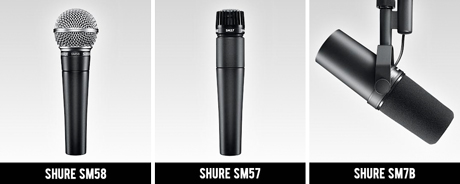
Dynamic mics are considered your typical stage mic. Most concert venues, churches, and so on use dynamic mics because they can handle high pressure sound levels, and they are used when the sound source is close and loud. The most popular dynamic mics are Shure SM58, SM57, and SM7B.

Shure-Mics
www.shure.com

PROs: These mics are fairly inexpensive, rugged, and road-worthy. The sound is pure and focused. They do not require phantom power (48v).

CONs: These mics can produce a nasal sound. They lack some high end (in comparison to condenser mics). They also have a pronounced proximity effect (the closer your source is to the mic, the more enhanced the bass sounds), so some EQ tweaking may be needed depending on the sound you are after.

Condenser Mics

Condenser microphones are the most common types of microphones you’ll find in recording studios. They have a much greater frequency response and transient response (which is the ability to reproduce the “speed” of an instrument or voice). They also generally have a louder output but are much more sensitive to loud sounds.

PROs: Much greater frequency and transient response. A louder output.

CONs: Often more expensive than dynamic mics. They can be very brittle with little low end. They require phantom power (48v). They are very sensitive to loud sounds and may require a pop filter for plosives ‘p’ sounds.

Different Types of Condenser Mics:

Large Diaphragm Microphones – Large diaphragm microphones (LDMs) are generally the choice for studio vocals and any instrument recording where a “deep” sound is desired. A large diaphragm microphone generally warms up the sound of what it’s recording. If using a condenser microphone for vocals, you’ll likely want to use a pop screen; these mics are so sensitive to transient noises that the “P” and “SH” sounds you make will cause distortion.

Small Diaphragm Microphones – Small diaphragm microphones (SDMs) are generally the best choice where you want a solid, wide frequency response and the best transient response, which, as we mentioned before, is the ability for your microphone to reproduce fast sounds (such as stringed instruments).

Good condenser microphones include the Audio Technica 2035, Oktava MC012 ($99), RODE NT1 ($199), and AKG C414B ($700)

www.audio-technica.com • www.oktava.com • www.rode.com • www.sweetwater.com

Once you have decided on the type of mic you are going to use, let’s go over mic positioning.

Mic Positioning

Recording Guitar and Vocals With One Microphone

Try to position the mic far enough away to capture the voice and guitar, but not so far that you capture the room sound. This is going to take some testing of various mic positions for the sound you want. Again, use your ears for best judgment.

As important as proper placement is, it’s even more important to use a mic with the right pattern. A cardiod mic in this scenario may work well because they reject sound from the rear. On the other hand, omni mics have a figure 8 pattern, which means they pick up sound from the front and rear of the capsule.

Recording Guitar and Vocals With Two Mics

If you’re using a large‑diaphragm condenser, you can achieve a useful improvement in the amount of separation by switching from cardioid pattern (where the null is behind the mic) to figure‑8 (where the null is perpendicular to the plane of the mic, and much deeper than in cardioid). How does this help? Using a figure 8 pattern or omni mic means that the null point will cancel the other mic out of its pickup. You may still have some spill, but you won’t have as much of a phasing nightmare.

Microphone Applications

Acoustic Guitar

A small diaphragm cardioid condenser is preferable here. As a starting point, aim it down so it’s looking at the 12th fret, and set it about 6-8 inches away.

Large diaphragm condensers can also work nicely on acoustic guitars, as well as ribbon mics. Have fun experimenting with different mics and placements to find what works best for you.

Vocals

When it comes time to overdub vocals, you’ll want a large diaphragm condenser mic. For a lead vocal, you should match the mic to the vocalist, who may have a personal mic preference.


As you can see, there are different techniques for different mics for different applications. There really is no standard setup. As I always tell musicians and engineers, use your ears to find out which mic and setup produces the sound you want.


...Keep Reading

Three Sources of Music Funding: The Story of Platinum Plaits

Three Sources of Music Funding: The Story of Platinum Plaits

By NationWide Source Estimated reading time: 6 minutes

Pretty much everyone knows the story of Goldilocks and the three bears, but, in case you don’t, here’s a recap: A curious (trespassing) little girl ventures into an “empty” house, where the three bears live. There she discovers three servings of food, dished out and ready to be eaten. With no one around, she takes that task upon herself. The first bowl is too hot. The second is too cold. The third? Just right. After sampling the food, a tired Goldilocks searches for a place to rest. She tries the chairs, finally settling into one… until it breaks. This leads her to look for another place of rest, and she tries each of the beds in the house until she finds one that suits her tastes. She falls fast asleep in that bed and is found there when the bears return home.

I’m willing to bet, though, that you haven’t heard the story of Platinum Plaits. Or, if you have, you don’t know it. So, grab some popcorn, get all cozy, and listen to this tale.

Who Is Platinum Plaits?

Not so long ago, in a land not so far away, there lived an indie artist named Platinum Plaits. At the wizened age of 28, she considered herself an experienced musician. After all, she’d been singing since the age of four, playing piano since seven, playing guitar since eleven, and officially gigging since she was sixteen. She was in three different bands before she decided to set out on her own five years ago. Since then, she’s played more shows than she can count, opened for some national acts, been invited to a few festivals, and even had a few TV appearances.

Yet, life was not all rose-colored glasses, custom tour buses, and quaint restored cottages. Far from it! Platinum Plaits had a serious dilemma: funding. It was always running, well, just a little short. So she did what any indie artist would do: pulled herself up by her bootstraps, put on her thinking cap, and started solving her problem.

Her brainstorming and research were fairly successful, as she came up with three possible solutions to her problem.

Solution 1: Crowdfunding The Old Way

Platinum Plaits had heard of this option from other indie artists. As she discovered, it wasn’t limited to musicians; there are crowdfunding platforms for dozens of fields!

Here’s how it works: an artist has a project in mind but not enough funds to complete it. They do a little research, set a budget, define participation levels and rewards, create a crowdfunding campaign, and send all of their existing fans to the campaign. Hopefully, those fans are invested in the artist enough to contribute; better yet, the fans contribute and tell their friends to contribute. The artist has a certain time frame to complete the campaign, which builds a sense of urgency with supporters. Depending on the platform, the artist gets what was raised (or not), minus a cut. They then have to use that money for their project, and they have to fulfill all of the rewards (which often costs more money).

To Platinum Plaits, crowdfunding seemed like a Thanksgiving feast: it’s more than enough for the occasion, and it sometimes results in leftovers for a few (much more sensibly-sized) meals… but it won’t feed you for a year. Or even a month. In other words, it could work for occasional surges of funding, but not ongoing, steady support.

Tabling crowdfunding for now but keeping it in mind as a possibility for an upcoming project, Platinum Plaits continued her search for a solution.

Solution 2: Sales and Shows

Like every active musician, Platinum Plaits could count sales of her music and cuts from shows as income. Unfortunately, it was getting harder and harder to make a living off of sales and shows alone.

Platinum Plaits’ fans often approached her merch table at shows, only to ask if her music was available to stream online or to tell her they’d bought one of her songs and really loved it. While she appreciated the sentiment and vocal support, the financial statements coming in from online retailers and streaming services paled in comparison to those lost sales of whole albums. She did offer her music for sale on her website—both physical albums and digital downloads of her albums; while those sales had higher profit margins than the sales from third party retailers, they still weren’t impressive.

And the profits from shows? Some performances paid well. Others… not so much, especially when she added up her travel expenses, marketing costs, fees for her backup musicians, insurance on her gear, and so on.

In short, the income from sales and shows was present, but much smaller than she needed for a sustainable career and not nearly steady enough to be reliable.

And so her search continued.

Solution 3: Patronage, or Crowdfunding the New Way

Somewhere on the fringes of the indie music realm, Platinum Plaits heard whispers of another solution: patronage. The idea wasn’t new, as the concept of “patron of the arts” dated back for centuries. But it was slowly rising from obscurity and becoming a possible source of funding for artists, including musicians.

The concept intrigued Platinum Plaits. Like other forms of crowdfunding, it spread the burden of funding out among the fans of the artist. Unlike crowdfunding, it wasn’t geared toward a specific one-time project. Instead, fans—or, rather, patrons—pledged a small amount—maybe $1, maybe $5—for every time the artist created something of substance. This meant that the more the artist created, the more income they had. Artists were being rewarded, monetarily, for doing what they wanted to do anyway: create something.

Of course, there were settings that fans could control, such as monthly spending caps or the ability to change their pledge (or withdraw it entirely) at any point. But patrons seemed to love the concept and the level of exclusivity and intimate involvement with the artist’s career that they felt it brought.

Unlike traditional crowdfunding, patronage didn’t leave artists sated then starving for funds. It also didn’t lure them along with a false hope of income or increasingly smaller payouts from sales and shows. It could, in theory, provide a steady stream of income to supplement sales and shows. Better yet, it did just that for many artists implementing this solution.

With her mind made up, Platinum Plaits adopted this solution for herself. Her truest fans were happy to support her and receive early access to her content, and she could focus on creating new material without wondering how on earth her bills would be paid. While she started out with only 40 supporters at $1 each, she quickly rose to a couple hundred supporters pledging anywhere from $1 to $10 per creation. This is only about 10% of her fanbase, but their support provides an extra $2000 a month… and the counts are still growing.

In the end, Platinum Plaits and her fans lived happily ever after.


...Keep Reading